
How Modular Classrooms Help Schools Handle Enrollment Surges
How Modular Classrooms Help Schools Handle Enrollment Surges
Enrollment growth rarely aligns with capital planning timelines. Districts can see student populations increase within a single academic year due to housing development, boundary changes, or program expansion, while permanent construction projects remain tied to multi-year funding cycles, design schedules, and permitting requirements. In many regions, more than half of public schools are already operating at or above designed capacity, leaving little flexibility to absorb sudden increases in student population.
At the same time, traditional school construction projects typically require 18 to 36 months from initial planning through completion, depending on project scope and approval timelines. That gap creates a practical challenge for school administrators who must respond quickly without compromising safety, compliance, or the quality of the learning environment.
Modular construction provides a way to close that gap. By shifting a significant portion of construction offsite and overlapping site work with building fabrication, modular classrooms allow districts to add capacity on compressed timelines while still meeting the same building codes and performance standards as site-built facilities.
The Core Challenge: Expanding Capacity on an Active Campus
Enrollment surges introduce more than just a space constraint. They create operational challenges that must be managed carefully within an active school environment. Construction cannot disrupt daily instruction. Student circulation, bus access, and emergency egress must remain fully functional throughout the project. At the same time, districts must work within defined budget cycles that often lag behind immediate enrollment needs.
There are also regulatory requirements that cannot be compromised. Classrooms must meet state education standards, local building codes, fire safety requirements, and ADA accessibility guidelines. In many cases, schools require more than general classrooms, including administrative space, restrooms, and support areas that function as part of the broader campus. Traditional site-built additions struggle to align with these constraints due to longer timelines and sequential construction phases. Modular construction addresses this by allowing site preparation and building fabrication to occur simultaneously, significantly reducing the time required to bring new classrooms online.
Why Modular Aligns With School Schedules
The ability to respond to enrollment surges is directly tied to how modular projects are planned and executed. Preconstruction begins with a detailed evaluation of enrollment projections, site constraints, and program requirements. Early coordination ensures that permitting, code compliance, and ADA accessibility are fully addressed before fabrication begins. Once design is finalized, modules are constructed in a controlled factory environment. This improves quality control and eliminates weather-related delays. At the same time, site work progresses independently, including foundations, utility installation, and campus integration.
Installation is where the schedule advantage becomes most visible. Modules are delivered and set using cranes, often within a matter of days. Follow-on work such as mechanical connections, exterior access systems, and interior finishes is completed in a tightly sequenced process designed to minimize disruption. For schools, this condensed installation window is critical. Major site activity can be aligned with summer break or other low-occupancy periods, reducing the impact on students and staff.
Modular Classrooms: Responding to Enrollment Pressure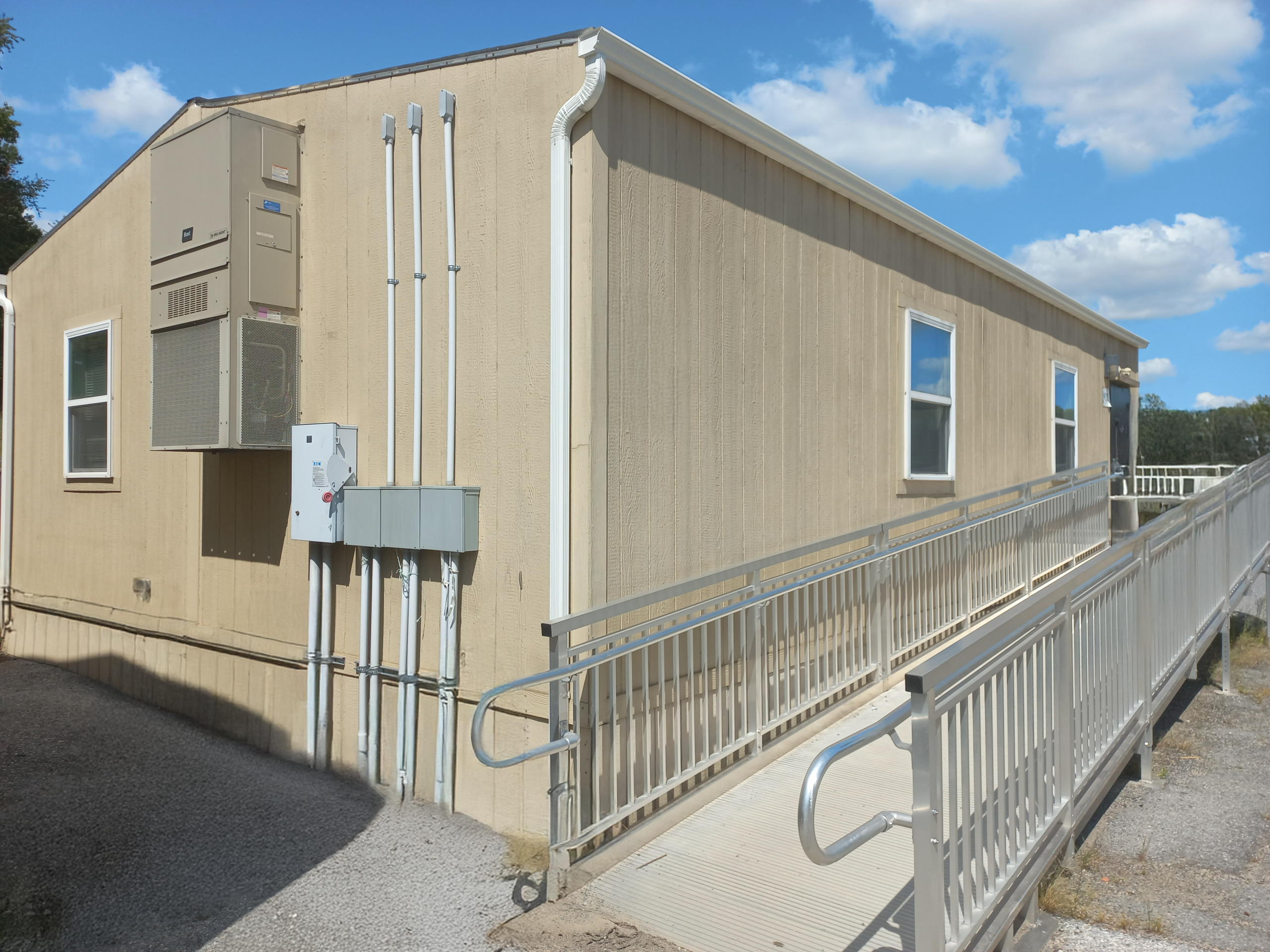
On a project recently completed by Modular Genius, an existing modular classroom building was relocated within the same school district to address shifting enrollment demands.
Rather than investing in new construction, the district leveraged existing assets to respond quickly to changing capacity needs. The project required careful coordination to disassemble, transport, and reinstall the building while maintaining its structural integrity and code compliance.
Key considerations included:
- Preparing the new site with appropriate foundations and utility connections
- Coordinating transportation logistics for multi-section modules
- Reestablishing ADA-compliant access, including ramps and landings
- Completing installation within a limited timeframe to align with the academic calendar
This type of project highlights an often overlooked advantage of modular construction. Buildings are not fixed assets in the same way as traditional construction. They can be relocated, reconfigured, and redeployed as enrollment patterns shift across a district.
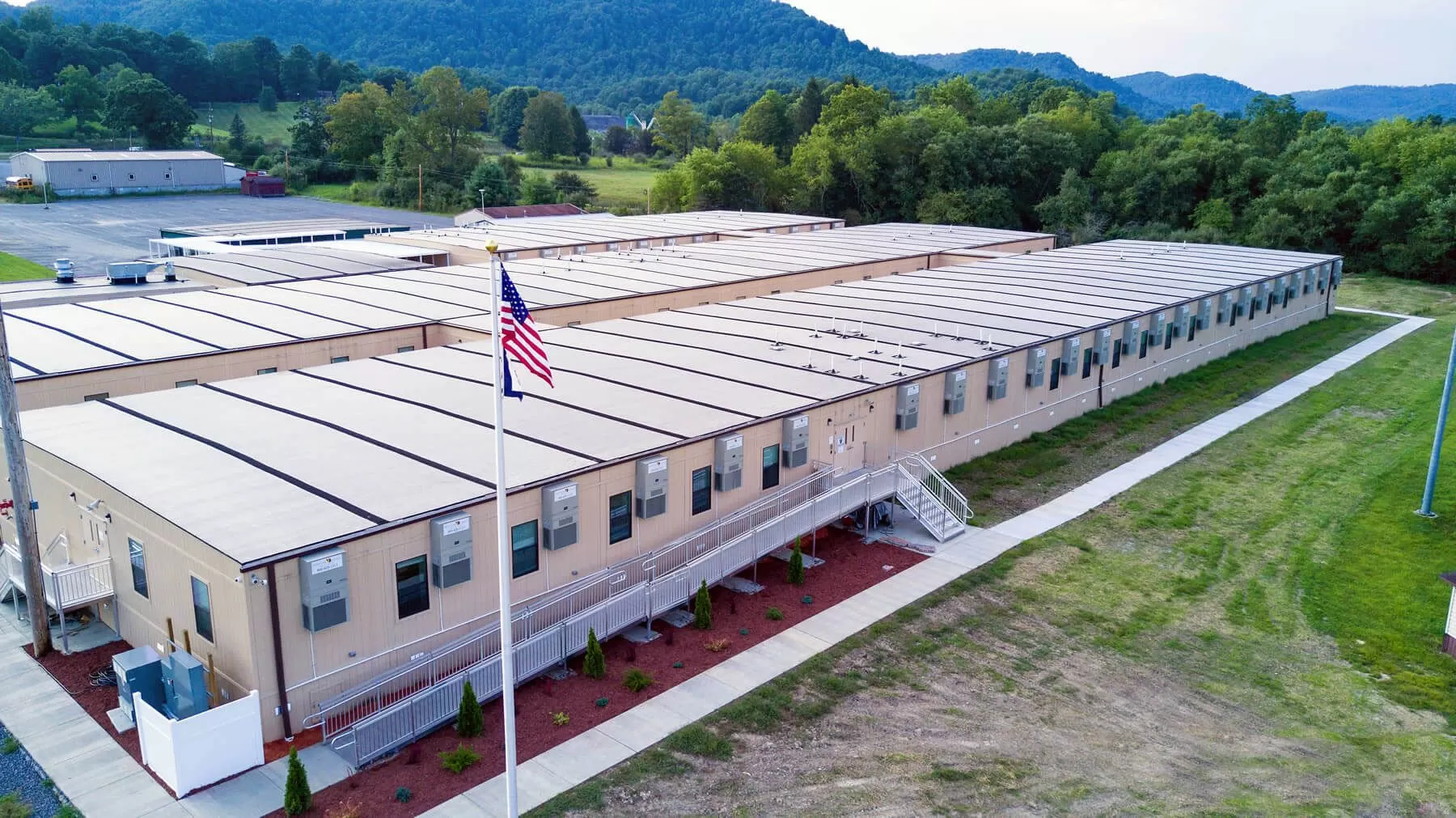
At Summersville Middle School, modular construction was used to create a full interim campus environment while long-term facility needs were being addressed.
The project involved the installation of a multi-building modular campus designed to support core academic functions. Rather than a small cluster of temporary classrooms, this deployment functioned as a cohesive educational environment, including classroom space and supporting infrastructure.
Project characteristics included:
- Multiple modular buildings configured to create a unified campus layout
- Integrated walkways and access systems to maintain safe student circulation
- Coordination of site development and building installation under a compressed schedule
- Delivery aligned with the need to maintain uninterrupted school operations
The scale of this installation demonstrates how modular construction can extend beyond short-term overflow space. It can be used to stand up fully functional school environments when timelines or site conditions make traditional construction impractical.
Flexibility as a Long-Term Facilities Strategy
Enrollment growth is not always predictable, but the response to it can be planned. Modular classrooms provide districts with a flexible way to expand capacity quickly while maintaining compliance, safety, and educational quality. Projects like classroom relocations and interim campuses illustrate that modular construction is not limited to short-term fixes. It is a scalable approach that allows districts to adapt their facilities over time, whether that means adding space, reconfiguring existing assets, or deploying full campus environments under compressed timelines.
When incorporated into long-term capital planning, modular construction gives school systems the ability to respond to changing enrollment conditions without losing control of schedule, budget, or operational continuity. As enrollment patterns continue to shift, school systems that treat modular construction as part of a broader facilities strategy will be better equipped to maintain continuity. Working with experienced partners who understand both the urgency and complexity of these projects allows districts to stay ahead of demand. This is the approach consistently demonstrated by Modular Genius, Inc. in active K-12 environments.